Upgrade to a Micro-Market
Transform your breakroom into an open-concept convenience store.
The Evolution of the Breakroom: Enter the Micro-Market
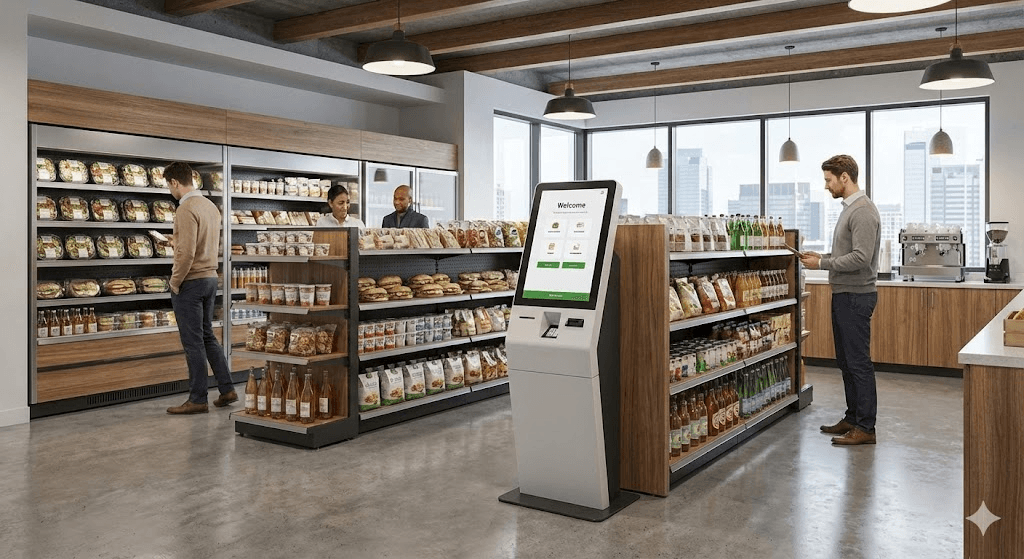
If the vending machine is a flip phone, the micro-market is a smartphone. It represents a quantum leap in breakroom technology and employee experience. A micro-market is essentially an unmanned, self-service convenience store located right in your office. Instead of products being locked behind glass and dropped into a bin, they are displayed on open racks, wooden shelves, and in commercial glass-front coolers. Employees walk up, browse the selection, pick up a fresh salad or a bottle of tea, scan the barcode at a self-checkout kiosk, pay, and walk away.
This "open market" concept has exploded in popularity. According to the National Automatic Merchandising Association (NAMA), micro-markets are the fastest-growing segment in the convenience services industry. They transform a sterile, utilitarian breakroom into a vibrant, inviting hub that fosters collaboration and relaxation.
1. Assess Feasibility: Is Your Office Ready?
Micro-markets are incredible, but they aren't for every location. Before you fall in love with the concept, you need to audit your space and culture.
- Population Size: The general rule of thumb is that you need at least 50 to 75 daily active employees to support a micro-market. Below that, the sales volume might not justify the cost of the fresh food (which spoils) and the equipment.
- Physical Space: You need a dedicated wall or corner. A typical setup requires 10 to 15 feet of wall space, access to multiple power outlets (for coolers and the kiosk), and a hardline internet connection (CAT5/6) for the payment system.
- Security Culture: This is the big one. Because the products are unsecured, micro-markets work best in "closed" environments—offices with badge access, employee-only areas, etc. They are generally not suitable for public lobbies with high transient traffic.
4. The Economics and ROI
For the employer, a micro-market is often a zero-cost upgrade. The vending operator typically covers the cost of the equipment, installation, and inventory. They make their money on the sales. In fact, sales in a micro-market are typically 50% to 100% higher than in a vending bank at the same location. Why? Because people buy more when they can touch the product, read the label, and aren't frustrated by a jammed machine.
5. Addressing Theft (Shrinkage)
The "elephant in the room" with micro-markets is theft. Operators call this "shrinkage." Surprisingly, theft rates in office micro-markets are very low—typically under 2%. Why?
- Accountability: Most kiosks require users to create an account or scan a badge. You know who is in the system.
- Social Pressure: In an office, no one wants to be "the guy who stole a Snickers bar" and get fired over $1.50.
- Technology: The camera system acts as a deterrent. If shrinkage spikes, the operator can review the footage.
Frequently Asked Questions (FAQs)
How much does it cost the company?
Usually $0. Unless you are subsidizing the food, the operator pays for everything. You just provide the space, power, and internet.
What if the internet goes down?
Most kiosks have an "offline mode" that allows them to store transactions locally. However, credit card processing might be paused until the connection is restored. It is critical to have a reliable internet line.
How often is it restocked?
Because fresh food has a short shelf life, micro-markets are serviced more frequently than vending machines—often 2 to 3 times per week. This ensures that the salads are crisp and the milk is fresh.
Can we customize the look?
Yes. The shelving, headers, and kiosk skins can often be branded with your company logo and colors to make the market feel like an integrated part of your office culture.